You can find out more about some of the important species the Trust helps to conserve using the links on the left. Watch this space for updates on other important species.
Focus on... red squirrels
For Save our Squirrels events in Northumberland August to October 2009 click here.
The Red Squirrel Hotline is now open, 0845 347 9375, or visit the Save our Squirrels web site www.saveoursquirrels.org.uk/
Why does the red squirrel need help?
Once common in woodlands throughout Britain, a glimpse of the red squirrel is now a rare sight. The north of England is the largest remaining stronghold for the red, and Save our Squirrels (SoS) is working to secure the future of this charismatic species.
The main reason for the decline is the grey squirrel. Introduced from North America in the 1870s, it has expanded its range and, through a combination of food competition and disease, has displaced the red.
Food Competition
Where red and grey squirrels share deciduous woodland, greys have the advantage. Grey squirrels are larger than the reds, eat more, and live at higher densities. Grey squirrels thrive on abundant acorns, which red squirrels do not digest as efficiently. The extra food gives the grey squirrels the competitive edge allowing them to breed more successfully than red squirrels.
As the population of grey squirrels grows, they eat more of the red squirrels' food. This reduces the chances of red squirrels breeding successfully, and makes it harder for juvenile reds to find enough food.
Disease
Grey squirrels also appear to carry and transmit a disease lethal to red squirrels; Squirrel Pox Virus (SQPV). The way in which this virus is transmitted is not known, however it may be via some sort of contact, such as scent marking. Red squirrels with the disease become very lethargic, and develop lesions around the eyes, feet and groin area. They tend to die within 2 weeks of contracting the virus, and often succumb to secondary diseases such as bacterial infections.
If you see a red squirrel with these symptoms please contact us or call the Red Squirrel Hotline, 0845 347 9375, as it may be possible for us to take steps to attempt to contain the disease outbreak. Please also see our information sheet on care of infected red squirrels. It is almost always best to leave a red squirrel, as attempting to catch it can be very stressful for the animal. Please also see our information sheet on feeding red squirrels for information on disease transmission at feeders.
I have seen a red squirrel that appears to be going bald!
Red squirrels moult twice a year, often resulting in large patches of bald skin. If the red squirrel appears otherwise healthy, there is nothing to worry about as it will most probably make a full recovery.
Mange is another potential cause of hair loss. If you suspect a red squirrel has mange, ensure that the feeder is thoroughly cleaned, or consider stopping feeding for a short time.
What is being done to save the red squirrel?
Red Alert North England (RANEng) is a partnership of conservation organisations, woodland owners, universities and the general public, united in their effort to save the red squirrel. Over the last few years, RANEng has developed a Conservation Action Plan to ensure that the north of England will remain a stronghold for this iconic native species.
We are pleased to announce that we have recently received funding from the Heritage Lottery Fund to help put this plan into action through a new project called Save our Squirrels (SoS). The SoS Team is now in place and is managed by Carri Nicholson, who is based at Northumberland Wildlife Trust. Also in this office is Philippa Mitchell, the Northumberland People and Wildlife Officer, Mark Wilkinson, the Northumberland Conservation Officer and Christine Westerback the Information and Support Officer for the whole project. Kelley Sprosten is the People and Wildlife Officer for Cumbria, who works closely with Simon O’Hare, the Conservation Officer for Cumbria, and both are based within the Cumbria Wildlife Trust Office at Penrith. Sally Orrit is the People and Wildlife Officer for the Sefton Squirrel Refuge and she is based within the Lancashire, Manchester and North Merseyside Wildlife Trust.
The team is actively involved in practical conservation work, providing opportunities to see red squirrels and encouraging people to learn about and get involved in red squirrel conservation. If you have any squirrel questions or squirrel sightings, please contact Chris Westerback or call the Red Squirrel Hotline 0845 347 9375.
Red Squirrel Reserves
The Species Action Plan for red squirrels has identified a number of forests offering the best opportunities for red squirrel conservation; Red Squirrel Reserves (click here for a map). The reserves are large conifer forests that will be managed in a way that will support a population of red squirrels, but will be less well suited to grey squirrels. The Reserves are surrounded by ‘Buffer Zones’; areas of land that will be managed to minimise the rate of grey squirrel invasion. It is in these areas that Northumberland Wildlife Trust and other partners of Red Alert will focus their red squirrel conservation efforts.
Information is available for owners of woodlands within these areas, and funding may be available from the Forestry Commission to undertake red squirrel conservation work. Read our Woodland Management for Squirrels Factsheet to find out more or contact The Forestry Commission at 1 Walby Hill, Rothbury, Northumberland, NE65 7NT, telephone them on 01669 621 591 or look at their website; http://www.forestry.gov.uk/ewgs.
How do I recognise a red squirrel?
As strange as it may sound, fur colour is not always the best way to tell squirrels apart as grey squirrels often have reddish fur on their heads and backs, and red squirrels can often have a grey tinge to the fur, particularly when they have a thick winter coat.
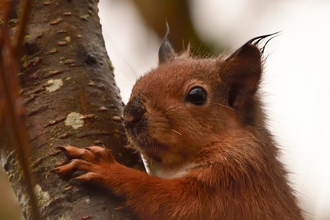
Rather than looking for the coat colour, look for ear tufts as only reds have ear tufts. Have a look at the tail too. The hairs of a grey squirrel have white tips, which gives a white 'halo' around the edge of the tail; reds do not have this.
| Red Squirrel | Grey Squirrel | |
| Body length | 18-22cm | 25-27cm |
| Ears | Tufted, especially in winter | Never tufted |
| Tail colour |
All one colour - red, black or blonde! About 14 to 20cm long |
Has white tips around the tail. About 21 to 22cm long |
| Body weight | 230 to 350g | 500 to 600g |
| Shape | Slender | Stocky |
| Habits | Shy - spends its time in the tree tops | Bold - often seen on the ground |
How can you tell if there are red squirrels present?
Both red and grey squirrels leave distinctive feeding remains on the woodland floor, including ‘stripped’ cone cores and cracked hazel nuts. Both species will leave the same feeding remains, so the only sure way to know which species is present is to catch a glimpse of the squirrel.
Where do red squirrels live?
Squirrels usually live in woodlands. Occasionally, they are found in the middle of fields, or on open moorland.
Woods are a good place to live, because they are full of undisturbed nooks and crannies in which to hide. A wood lasts a long time - so any good places to shelter are likely to be there for a long time. Squirrels live in all types of woodland. They have a home area of up to 7 hectares (roughly 65 football pitches!), which they explore when looking for food and shelter.
Having a warm and safe place to sleep, shelter and raise a family is a top priority for any animal. In the squirrels' case, the home can be either a natural tree hollow or a nest it makes itself. These two types of home are know as dens and dreys.
A den is a hollow space in a tree (this may have previously been made by a woodpecker), which the squirrel lines with soft and warm leaves, grasses and mosses. This provides an excellent safe and warm place for the squirrel to sleep and shelter from the elements. Dens are always hard to find because they are hidden away; they are generally built up in a tree and are often only spotted when you actually see the squirrel disappear inside.
Dreys are about the size of a football and look like a ball of twigs, nestled on branches next to the tree trunk. The nest is constructed of twigs and sticks that the squirrel carefully makes into a shelter. The twigs are built so that the centre is hollow, then this hollow is filled with soft material, just as with the den. The squirrel makes the nest by carefully selecting twigs, nibbling them off and then putting them into place using its teeth and front paws. A squirrel may make many trips back and forth to make its drey. A well made one may last for two or three years, through wind, rain and storms.
Making a nest on the outside of the tree means that it might be more exposed to the wind and rain. To try and solve this problem the squirrel is careful about where it makes its drey. Right in the middle of the tree, near the trunk is a much better place than out on the end of the branches. Near the trunk, there will be more leaf cover to protect from the rain, and the branch will move less, making it less likely that the drey will be blown or shaken apart. The squirrel also makes its drey quite high up in the tree (over 5 metres). The higher up the squirrel, the less likely it is to be found by ground predators like foxes or cats.
Just as squirrels will happily find enough to eat in both conifer and deciduous woods, they are also equally happy to make their nest in either coniferous or deciduous woods. Red squirrels seem to be more successful in coniferous forests, while grey squirrels prefer broad-leaved forests.
Squirrels normally use more than one drey or den at a time, swapping every few days. This provides them with an alternative home if their nest becomes wet or is destroyed in bad weather. It also allows the squirrels to reduce the level of parasite infestation they suffer by leaving parasites behind in the nest. Red squirrels are able to move themselves and their young between dreys.
Active red squirrel dreys are legally protected by the Wildlife and Countryside Act, and as such it is an offence to disturb one.
What do red squirrels eat?
Shelter isn't the only reason that squirrels live in woods. The other reason is equally important - woods are good for squirrels because they offer an abundance of food.
Squirrels will eat a very wide range of foods. What they eat at a particular time depends very much on its availability. This is called non-selective feeding. Of all the foods eaten by squirrels, tree seed is the most important. This includes such things as pine seeds, beech nuts, acorns and hazel nuts. These are all large seeds and they provide a lot of food for the squirrel.
Some of the other things that the squirrels eat include fungi, flowers, berries and shoots. These are all available at different times of the year and eating them when they become available helps the squirrel through the year.
Feeding red squirrels in your garden can enable you to see the animals at close quarters, and is a useful food source for them. However, there are a number of risks associated with this and it is vital that any supplementary feeding is carried out properly. Please see our information sheet for further details.
Do Squirrels Hibernate?
No. Squirrels are active virtually every day, including in winter. Unlike dormice and bats, which put on lots of body fat and then hibernate, the squirrel keeps on going right through the winter. During the autumn the squirrels do put on body weight - but nowhere near enough to make hibernation possible. Only really windy, cold or wet weather keeps the squirrels tucked away in their nests, but if the weather stays bad for a few days they will have to come out and search for food anyway.
Squirrels are most active first thing in the morning - one or two hours after dawn is the best time to see them! Once they've digested their last meal they will be active at other times throughout the day, but this varies. The search for food is never ending, and this is nearly always the reason why squirrels are out and about.
What are the red squirrel’s predators?
Red squirrels have a number of predators, including birds of prey, foxes and cats. It is vitally important that feeders are not positioned in a location which will put the red squirrels at risk of cats.
Red squirrel road deaths
Unlike their namesake Tufty, red squirrels do not have road sense and every year we receive reports of squirrels that have been run over on roads. Our message to drivers is to slow down, particularly when driving through wooded areas. Feeders should not be placed in a location which will encourage red squirrels to leave a woodland to cross a road.
SoS can provide people with information about road signs and putting rope bridges across roads which are known death traps for red squirrels. Please contact us or call the Red Squirrel Hotline 0845 347 9375 for further details.
Where do I look for red squirrels?
Red squirrels are present throughout Northumberland; - we have about 80% of England’s red squirrels here. A sighting of a red squirrel is never guaranteed, however your chances of seeing one are greatly increased if you get up early in the morning (red squirrels are most active during the first few hours after dawn). The autumn is a good time to see squirrels searching for seeds, nuts and other foods, but you are less likely to see them on feeders as there is so much natural food. The best time to see red squirrels at feeders is in the winter and summer when natural food is scarce.
Suggested locations include:
- Plessey Woods
- Gosforth Park
- Bolam Lake
- Ford and Etal
- Thrunton Woods
- Cragside
- Kielder Forest
Kielder forest has the biggest population of red squirrels in England so there is a good chance you will see one there, especially at the wildlife hide near Leaplish.
Wallington Hall has a wildlife hide at which red squirrels are regular visitors. Killhope lead mining museum also has a red squirrel hide. It is recommended that visitors contact these places prior to visiting to check opening times and admission fees.
I have seen a squirrel, do you want to know about it?
We have a database of thousands of sightings that have been reported to us by members of the public. These sightings are very useful as they help to maintain an up to date picture of the distribution of squirrels in the region. The records are also given to researchers who use them to study a range of red squirrel conservation projects.
We are in the process of loading our database on to the National Biodiversity Network website. See www.searchnbn.net, and type in "red squirrel" to the search box.
All sightings are double-checked, given a grid reference, and typed in to an excel spreadsheet. If you are able to help with this, even for a few hours, please contact us.
We have an on-line sighting form which you can download here.
When reporting a sighting, please supply the following information:
- What you've seen
- Location (including grid reference if possible)
- Postcode
- Date
- Habitat type
- Your name
- Address
- Telephone number
If you have any questions on squirrels and squirrel conservation, please contact our red squirrel officer, Philippa Mitchell.