Merry Swiftness!

Merry Swiftness!

What a year it’s been for our swift groups in Newcastle & South-East Northumberland! Read our latest blog about the collective action communities are taking to protect swifts and how you can get involved with the project in 2026. 

Merry Swiftness!

         - Cathy Sharp, Communities Officer.


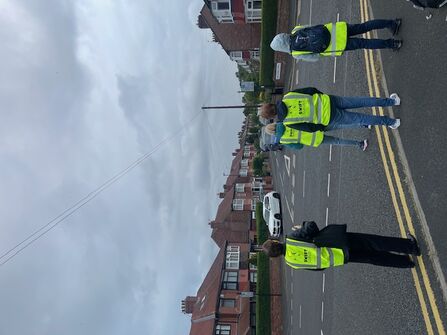
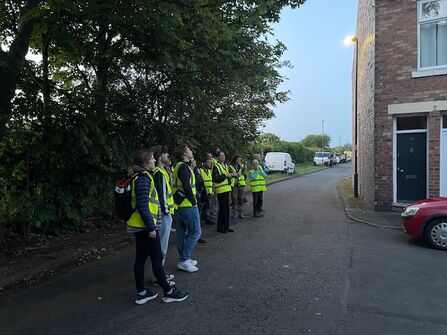
2026 is a big year for our Swift Project as juvenile swifts from the first year of the project are now old enough to breed and will be looking for nests of their own. We have spent the last three years working with communities, upskilling residents to survey swifts and then add their findings to the RSPB App ‘Swift Mapper’ Swift Mapper. This data helped pinpoint ideal locations for installing swift nest boxes - by May 2026 we will have installed over 120 swift boxes across Newcastle and South East Northumberland, thanks to funding by Newcastle City Council, the Natural History Society of Northumbria, Ashington Town Council and the RSPB. There are now three established swift groups in the region with two more emerging.

Swifts are on the red list of Birds of Conservation Concern. Sadly, there has been a 62% decrease in population numbers from 1995 to 2022. Many North East residents look forward to the return of the swifts in May, with the familiar swift call heralding the start of summer, but over the years have noticed this dramatic reduction in numbers. The main reasons for the decline are:

  • Lack of nest sites: Swifts have adapted to urban life for millions of years, nesting in tiny gaps in roofs and eaves. Modern renovations and roof insulation projects often block these spaces, leaving returning swifts without their traditional breeding sites.
  • Lack of insects: The 2024 Bugs Matter survey shows a 63% decline in UK insect populations since 2021. Swifts spend most of their lives flying and rely entirely on airborne insects for food, so this drop has undoubtedly had an effect.
  • Climate change: Swifts migrate up to 14,000 miles annually, crossing 25 countries at a top speed of 70mph. Harsh springs and heatwaves during migration can cause starvation or overheating in nests, and these risks are increasing with climate change.

Earlier this year the Swift Brick Amendment was rejected by the UK government. This would have required at least one low-cost nesting brick for house-nesting birds in every new home. This, along with the removal of Amendment 40 from the Planning and Infrastructure Bill (Planning and Infrastructure (England) Bill | The Wildlife Trusts), means that the future of swifts now depends on community-led projects like ours.

The good news is that there's growing concern across the UK about the future of swifts; linking into the national Swifts Local Network has provided a hugely supportive network for sharing best practice. These partnerships came together at a dedicated swift conference in Lancaster in November, where participants shared knowledge, research, and resources and explored strategies for safeguarding swifts through coordinated campaigning and influencing legislation.

Swift Conference by Cathy Sharp

Swift Group by Cathy Sharp

Locally, the project also inspired an MSc dissertation by James Matlock, a Conservation and Ecosystem Management student. His research compared colonies in Hazlerigg and Kenton in Newcastle, and helped to clarify the factors affecting swift nesting habits in these locations. James was awarded a distinction and presented his findings at a talk hosted by the Natural History Society of Northumbria in December. You can read his dissertation here: Research Dissertation - swift Project.docx (2).pdf

Swift Natural History Society of Northumberland talk

Swift Natural History Society of Northumberland talk by JM

As a Communities Officer, what I love about this project is that it’s a fantastic way for people living in urban areas to connect with wildlife right on their doorstep. Anyone can survey swifts; there’s no special equipment needed. It’s just a matter of taking a walk around the streets where you live in the summer months, and quietly watching swifts return to their nests in the evening. I have seen first-hand the joy this can spark and how it can inspire a real sense of local pride. 

We are looking forward to the development of two Swift Streets next Spring - this celebrates the community effort made in two streets in Newcastle with thriving swift colonies and a fantastic uptake of swift boxes. We’ll also continue to offer survey training, survey swifts, install and monitor swift boxes, and campaign for swift protection.

Huge thanks to Nathan and Harvey from Security Serious who have installed all of our swift boxes.

If you’d like to get involved, or know of swifts nesting near you (or at risk from scaffolding or reroofing), please email: cathy.sharp@northwt.org.uk.